

Ambition?
Science?
Dedication?
Funding?
All of these are essential. But there is something else that brings them together.
Strategy.
You see…
Spending nights tracking coral spawning and collecting coral gametes, only to release them back into the ocean a few hours after fertilization may not help repopulate reefs as intended. Out planting corals in locations where environmental conditions remain unsuitable will most likely result in high mortality. Using antibiotics to halt a disease outbreak without fully understanding the impacts on surrounding species and ecosystems may create unintended consequences for reef health.
If we want to rewrite the future for corals, and ensure that our collective efforts, resources and expertise deliver the greatest possible impact, we need a clear strategy.
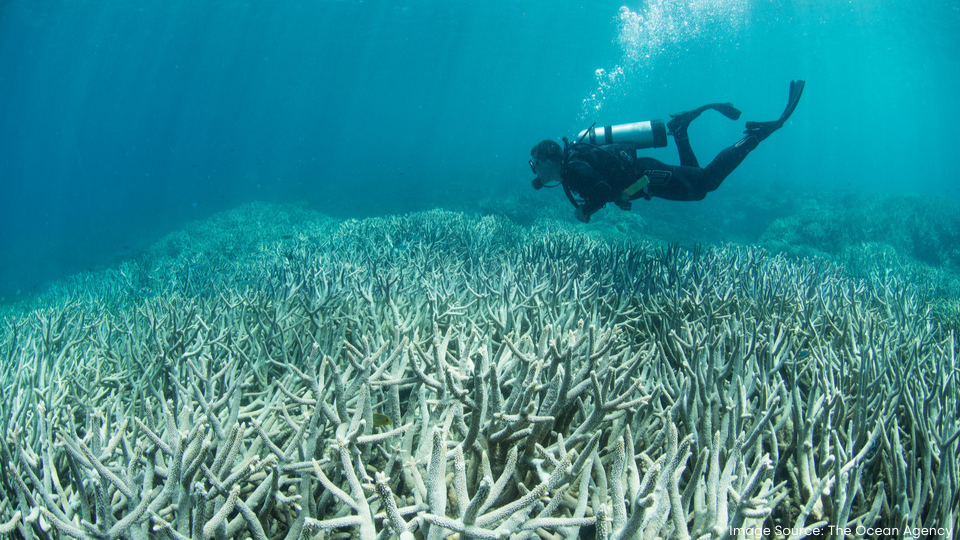
Diver swimming over bleached corals. Credits: The Ocean Image Bank
Revisiting the past and planning the future ahead
With this in mind, CORDAP’s Scientific Advisory Committee met late last year to evaluate progress against the Strategic Plan 2022-2025. Bringing together leading coral experts and scientists from around the world, the committee identified critical knowledge gaps, revisited priority areas requiring further research and investment, and reviewed key milestones and achievements. Reflecting on the successes of the past four years and the lessons learned along the way, they developed CORDAP’s Strategic Plan 2026-2029.
While grounded in the progress we have made, this new strategy looks firmly to the future and it scales the next phase of our journey. It considers not only CORDAP’s growing impact, but also the current trajectory and projected future of corals and reef ecosystems worldwide.
The current and forecasted status of corals
Corals and reefs are among the ecosystems most vulnerable to human-driven pressures, particularly those associated with climate change. We are witnessing accelerating declines driven by unprecedented marine heatwaves that continue to increase in frequency and intensity. At the same time, deep-sea corals, which represent most of the world’s coral diversity, face additional threats from ocean acidification, destructive fishing practices and seabed disturbance. Many tropical coral reefs remain resilient and retain the capacity to recover if conditions allow. Yet the window of opportunity for recovery is rapidly narrowing. The impacts are being felt across every ocean basin, from the Pacific and Atlantic to the Indian Ocean, and from the equator towards the poles.
The consequences extend far beyond corals themselves. They affect countless species that depend on reefs for habitat and survival. They also threaten the hundreds of millions of people who rely on healthy coral reefs for food security, coastal protection, livelihoods and cultural identity.
Scaling the next phase of CORDAP’s journey
Globally, we must move towards more active ecosystem interventions. Taking direct and widespread action now can help corals withstand the impacts of climate change and other growing threats, reducing the number of reefs lost in the coming decades. This includes approaches such as propagating sexually heat-tolerant coral recruits, assisted migration, cryopreservation, biobanking, and other emerging interventions. While many of these techniques show considerable promise, their success has so far been limited by the challenges and costs associated with scaling them effectively.
This is where CORDAP has a unique role to play.
We aim to strengthen global coherence by supporting and complementing national, regional and international initiatives already working to conserve and restore corals. Rather than duplicating existing efforts, we focus on critical research and development functions that are not being addressed elsewhere, ensuring that every dollar invested helps move the global coral community further, faster.
CORDAP’s Strategic Plan 2026-2029 outlines how we will deliver on this ambition. It details our programs, our approach to mobilizing resources, our pathway to impact, and the strategic priorities that will guide our work over the next four years.
Because when it comes to saving corals, ambition alone is not enough.
We need science. We need innovation. We need collaboration.
And above all, we need a strategy that turns all of these into action.