
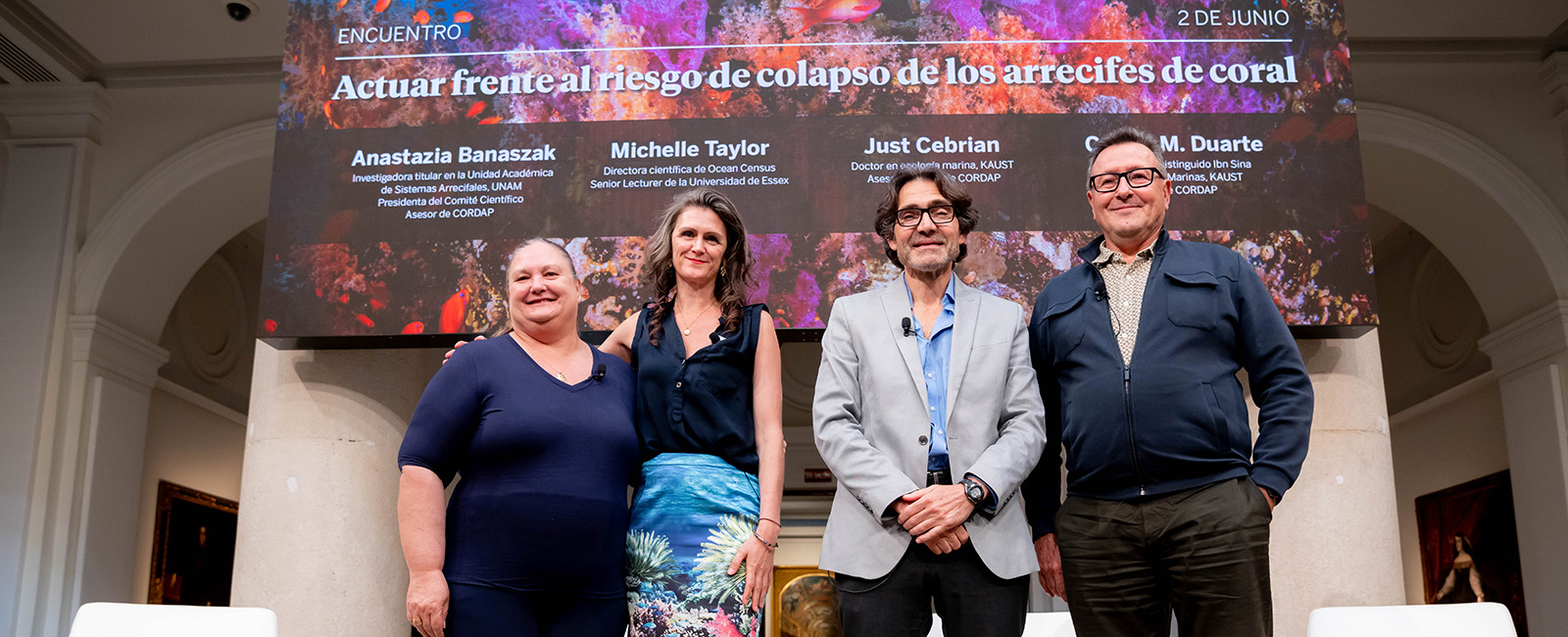
CORDAP’s experts spoke at the BBVA Foundation event to raise awareness on the need to secure a safe future for corals
The event Acting on the Risk of Coral Reef Collapse took place on June 2, 2026, at the BBVA Foundation’s headquarters in Madrid, where CORDAP’s experts raised public awareness of the situation facing tropical and cold-water corals and of potential strategies to halt their decline.
“The world’s coral reefs are on the front lines of the climate emergency,” said Carlos Duarte, CEO of CORDAP, and Ibn Sina Distinguished Professor of Marine Science at the King Abdullah University of Science and Technology (KAUST), to a room full of people looking attentively to the beautiful pink coral landscape featured on the huge board. “This isn’t just about preserving a beautiful underwater world. These ecosystems support one-third of all marine species and provide essential coastal protection, fisheries resources, and biotechnological assets. As a result, coral reefs generate hundreds of billions of dollars annually and support the livelihoods of hundreds of millions of people.”
“A range of innovative solutions to conserve and restore coral reefs are being tested at a larger scale, demonstrating the real-world impact of CORDAP research and initiatives. Saudi Arabia’s Ministry of Environment, Water and Agriculture (MEWA), together with the support of King Abdullah University of Science and Technology (KAUST), have been instrumental in these achievements, demonstrating the leading global role of the Kingdom of Saudi Arabia on the mission to secure a future for coral reefs.” said Professor Carlos Duarte, CEO of CORDAP.
The concerns raised by Professor Duarte are well founded. Coral reefs face a global crisis. Threats come from many fronts: a warming ocean, changing coastal land use, pollution, overfishing, lethal diseases, habitat destruction, among others. Between 1970 and 2020, approximately half of these marine ecosystems disappeared, and experts predict that 99% of coral populations will be lost if global warming reaches 2 °C above pre-industrial temperature levels.

Professor Carlos Duarte speaking at Fundación BBVA, June 2026. Credits: BBVA
If these current trends in coral degradation continue, Professor Carlos Duarte warns that the absence of corals will have a cascading effect: “from the collapse of fisheries and increased coastal erosion to threatening the very existence of low-lying island nations, which will be deprived of the protection that reefs have provided for millennia.”
There is, however, still time to act and avoid this scenario. This event, organized in collaboration between the Fondación BBVA and CORDAP, aimed to convey the message that science and technology can provide the tools needed to increase coral resilience, predict degradation, and scale up restoration efforts. Approximately 80 members of the public attended the talks.

From left to right: Dr. Anastazia Banarszak, Professor Michelle Taylor, Dr. Just Cebrian and Professor Carlos Duarte. Credits: BBVA
The event began with Dr. Anastazia Banarszak, Senior Researcher at the Reef Systems Academic Unit of the Institute of Marine Sciences and Limnology of the National Autonomous University of Mexico (UNAM) and Chair of CORDAP’s Scientific Advisory Committee, presenting the progress achieved to date in conserving Caribbean coral reefs, as well as the challenges that remain in preventing their disappearance.
Next, Professor Michelle Taylor, member of CORDAP’s Scientific Advisory Committee, Senior Lecturer at the University of Essex, and Scientific Director of Ocean Census – an international initiative dedicated to discovering new marine species – shared her perspective on how to accelerate scientific research and implement measures to conserve deep-sea coral habitats.
Dr. Just Cebrian, a marine ecologist and Special Program Advisor to CORDAP, outlined the latest advances achieved by CORDAP in coral conservation and discussed new proposals to strengthen coral protection in the future.
Finally, Professor Carlos Duarte closed the event with a talk highlighting the significance of preventing global collapse of coral ecosystems, a goal he describes as “a generational responsibility.”
“Even with the best science and technology, preventing the loss of coral reefs will require a global collaborative effort,” Professor Duarte stresses. “We have the capability, but we need the coordination, financing, and political will. Gathering these elements is not impossible – we have seen the world mobilize and cooperate at this scale before to address the COVID-19 pandemic.”