

The fourth global coral bleaching event likely concluded in mid-2025, but shifting sea surface temperature and air pressure of the overlying atmosphere indicate an El Niño is developing in the Pacific Ocean. What does this mean for corals across the world?
From early 2023 to mid-2025, bleaching-level heat stress impacted 84% of the world’s coral reef area in all three coral reef-containing basins: the Pacific, Atlantic, and Indian Oceans. Sea surface temperatures reached a shocking 37.8 ºC (100℉) off the coast of Florida in 2023, making the waters feel like a hot tub and turning these once vibrant reefs stark white. Raja Ampat, an Indonesian archipelago surrounded by some of the most diverse coral reefs, sat in the center of the highest alert levels for coral bleaching in December 2024. Despite these bleaching-level conditions and ensuing bleaching across reefs in the region creating a patchwork of colorless corals, surveys in November 2025 showed widespread repigmentation across the dominant coral taxa, Pachyseris speciosa, commonly known as the Serpent Coral or Ringed Plate Coral. Coral bleaching is not an immediate death sentence. Coral can still survive if given the chance. These findings underscore the importance of identifying and protecting potentially resistant hotspots, as well as corals’ capacity for recovery in the face of global climate change.
Coral bleaching happens when the microscopic algae that live inside corals abandon them. These algae have a symbiotic relationship with corals – they provide corals with nutrients from photosynthesis, and corals provide them with a place to live and ammonia-rich waste products that the algae recycle. This win-win situation also gives corals their vibrant hues. Heat stress from increasing water temperatures and UV radiation can trigger corals to evict the algae, bleaching them of their vivid visage. Without the algae, bleached corals are not dead, but they are more at risk of starvation and disease.
![Bleached corals in Ningaloo, Western Australia, February 2025 [Credit: Daniel Nicholson / Ocean Image Bank]](https://cordap.org/wp-content/uploads/OceanImageBank_DanielNicholson_09-scaled.jpg "OceanImageBank_DanielNicholson_09")
Bleached corals in Ningaloo, Western Australia, February 2025 [Credit: Daniel Nicholson / Ocean Image Bank]
Thermal-induced bleaching is one of the greatest threats to corals, but reefs can rebound from bleaching events. The conditions under which corals bounce are not well understood, but reef depth and structural complexity pre-bleaching appear to be the most significant indicators of reef recovery. The recovery process also depends on the community of algae and bacteria surrounding the reef, as well as on the genomic resilience of the coral. Recovery is often gradual. Some corals regain their symbiotic algae within a month as conditions improve, but others, in particular slow-growing species, can take up to a year.
While NOAA experts have confirmed that global heat stress has been declining in some regions since mid-2025, rapidly changing ocean conditions due to climate change have introduced a new era of global bleaching. The first global-scale coral bleaching event (GCBE) started in 1998, but the sea surface temperature conditions of the last decade have consistently exceeded those of that first event, indicating a new regime of near-annual bleaching events. Every strong El Niño event since 1998 has been associated with a GCBE.
“We are now in the era where reefs will bleach on a near-annual basis, which means defining when global events begin and end is becoming increasingly difficult,” said Derek Manzello, Coordinator of NOAA’s Coral Reef Watch. “The plan moving forward is to rely on field bleaching observations to determine if and when global events are happening.”
![Coral bleaching on the Great Barrier Reef, 2017 [Credit: The Ocean Agency / Ocean Image Bank]](https://cordap.org/wp-content/uploads/OceanImageBank_TheOceanAgency_Bleaching_09-scaled.jpg "OceanImageBank_TheOceanAgency_Bleaching_09")
Coral bleaching on the Great Barrier Reef, 2017 [Credit: The Ocean Agency / Ocean Image Bank]
El Niño and the Southern Oscillation (ENSO) is a periodic fluctuation in sea surface temperature (El Niño) and the air pressure of the overlying atmosphere (Southern Oscillation) across the equatorial Pacific Ocean. Typically, lower atmospheric pressure near Australia and higher atmospheric pressure near South America encourage a circulation of air from east to west, creating trade winds that pull warm surface water to the west and make space for cold, nutrient-rich water from the depths to move upward along the western coast of South America. The movement of warm water also brings precipitation to Australia and the western Pacific. El Niño conditions reverse this wind trend, causing drought conditions in Australia and the western Pacific and wet conditions on the west coast of North and South America.
As the typical wind patterns decline, upwelling of cold, nutrient-rich water from the deeper ocean along the western coast of South America decreases. This allows warm surface water to build in this eastern part of the ocean basin, creating heat stress conditions for the corals living in these waters and beyond. Changes in sea level height are also associated with El Niño events and can have impactful effects on shallow water coral reefs. During an El Niño event, the sea level may significantly drop below the norm in the western Pacific and increase in the eastern Pacific, leaving coral reefs from low depths exposed to air at low tide, and thus more vulnerable to UV radiation.

NOAA Coral Reef Watch’s four-month bleaching forecast shows the percent probability of alert level 1 and 2 bleaching risk across the globe. [Credit: NOAA Coral Reef Watch]
NOAA’s Coral Reef Watch monitors sea surface temperatures to generate a four-month coral bleaching outlook. The prediction published on July 21, 2026, indicates a high risk of coral bleaching across the globe from August through November. With this forecast anticipating difficult times for corals and for the coastal communities that depend on them, CORDAP-funded projects are progressing towards solutions to improve coral reef resilience in the face of these bleaching events.
Studying how corals respond to rising temperatures helps us better understand their resilience and develop and improve coral restoration strategies and techniques used worlwide.
CORDAP currently funds several projects that aim to evaluate and improve coral community responses to heat stress events. Researchers are working in the Eastern Tropical Pacific, the South Pacific, and the Indian Ocean to identify and evaluate what role different microbiomes, which include algal partners and beneficial bacteria, play in heat resistance. Other projects seek to create and integrate new technology into improving understanding of coral colonies, including a handheld fluorometer to monitor fluorescence of algae inside corals, probiotic supplements to improve coral resilience, and sound recording devices to monitor the soundscapes of healthy and degraded reefs. CORDAP also funds projects that build capacity in areas most impacted by coral bleaching through knowledge-sharing events and training series and through novel, open-access frameworks and restoration strategies for coral conservation.
To guide future activities and investments, CORDAP produces actionable roadmaps and scoping studies in collaboration with members of the Scientific Advisory Committee and partner organizations, such as the Australian Institute of Marine Science (AIMS), the Centre for Environment, Fisheries and Aquaculture Science (CEFAS), and the KAUST Reefscape Restoration Initiative. These roadmaps are strategic action plans that guide global research, technology development, and funding investments to protect and restore coral reefs. They identify knowledge gaps, prioritize regional needs, and coordinate international conservation efforts.
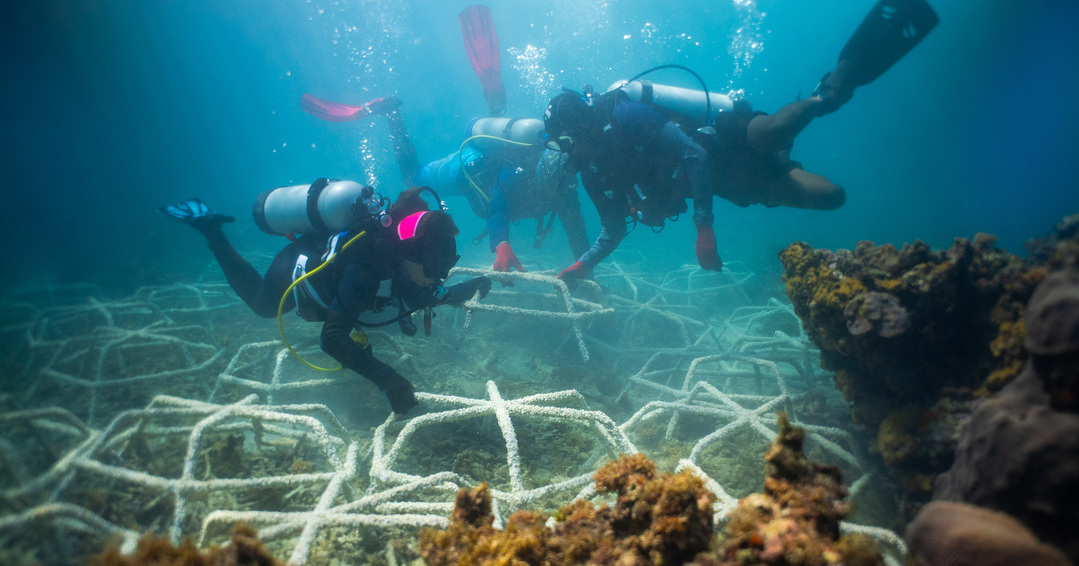
Researchers visiting a coral restoration site in the Dominican Republic [Credit: Marvin del Cid]
“The only action able to avoid even more severe coral bleaching events is to mitigate climate change by reducing emissions to meet, or improve, the most ambitious of the scenarios of the Paris Agreement, to contain climate change at 1.5°C warming above preindustrial levels. Unfortunately, average ocean temperatures have been at record levels, nearly 1.5°C above preindustrial levels, every month already since March 2024,” states Professor Carlos Duarte, CORDAP Executive Director. “This is why CORDAP is investing in R&D projects that fund the best ideas for international teams to advance our capacity to conserve and restore corals, as heat waves will, otherwise, do away with years of restoration efforts.”
Now is the time to work together to face the challenges ahead. We still have to anxiously wait and see if the recently established El Niño will cascade into another global coral bleaching event. We must stay alert and communicate any bleaching reports.
Without corals, the world will lose not only the beautiful seascape that holds thousands of species awaiting to be discovered, but also the economic and ecological benefits of coral reefs. Coral reefs provide ecosystem services that sum to at least 1 trillion USD per year, from wave absorption during storms mitigating flooding events to the wide range of sea life providing food for over half a billion people and supporting the fishing industry. Coral reefs are also home to one third of all ocean life, harboring the highest biodiversity of any ecosystem globally.
Saving corals is not an option or a whim. It’s a global mission we must all sign up for to secure life on Earth as we know it.
Find out more about the work we are funding around the world to help restore and conserve corals, and learn how you can help make a difference as part of #TeamCoral.